
How can you compare accounting quotes in Hong Kong when one firm counts your invoices and another counts your bank lines? That question sits behind nearly every bookkeeping fee an owner reviews. The monthly headline is rarely a like-for-like price.
A single sale can consume one unit under one provider's method and two under another's. A transfer between your own accounts may count twice, or not at all. Once software, report frequency and year-end fees enter the picture, two quotes for 'monthly bookkeeping' stop describing the same service.
The gap matters most for Hong Kong small and medium-sized enterprises (SMEs). Pick on the headline and you may overpay for unused capacity, or underbuy and settle overages every month. It also shapes what your accountant can deliver, and when, during audit season.
Our team proposes starting with one workload brief and normalising transaction definitions and first-year budgets. We also suggest checking payroll, Mandatory Provident Fund (MPF) support, audit boundaries and engagement terms. This is the team's proposed professional judgement and still needs practitioner confirmation. The provider labels, quotes, fees, caps and calculations are hypothetical, not collected quotations. The sample workload, reporting deadlines and audit allowance are assumptions that need confirmation. In this blog, we discuss how to build that comparison on a like-for-like basis.
How Do You Compare Accounting Quotes in Hong Kong Fairly?
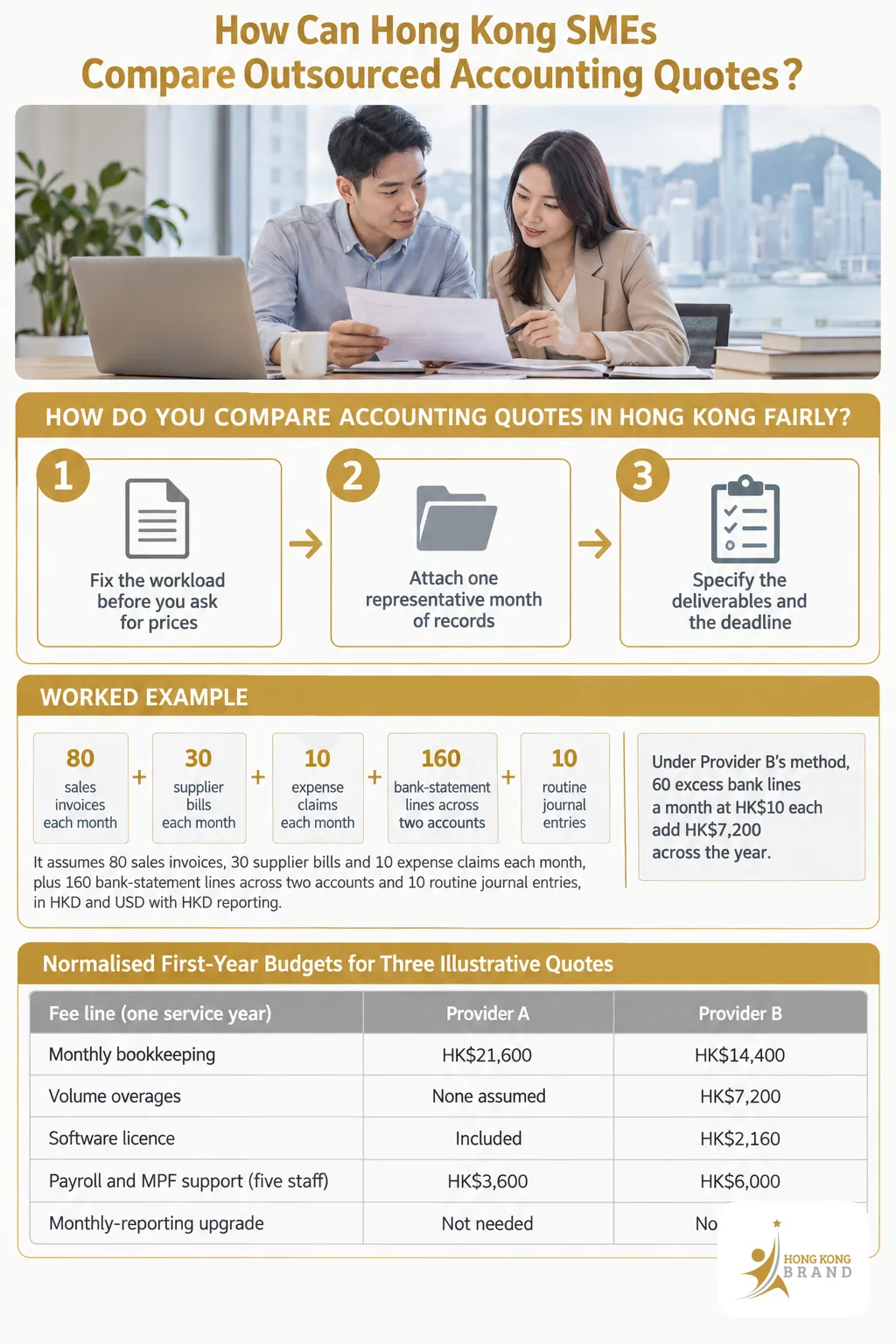
You start by fixing the workload, not by collecting package prices. Our approach is to send every provider the same written brief and ask each one to price that document, nothing else. The brief carries your company profile, monthly volumes, accounts, currencies, reporting needs and a deliverables list. For online sellers, ecommerce bookkeeping needs can include order and refund activity.
1. Fix the workload before you ask for prices
Our illustrative brief describes a Hong Kong trading or services limited company with no inventory. It assumes 80 sales invoices, 30 supplier bills and 10 expense claims each month, plus 160 bank-statement lines across two accounts and 10 routine journal entries, in HKD and USD with HKD reporting. The sample also assumes five employees needing payroll processing, MPF schedules and submission support. These volumes and tasks are assumptions, not a measured average. Replace them with your own transaction volume before you brief anyone. If you sell online, our bookkeeping tips for e-commerce businesses can help you estimate order and refund counts first.
2. Attach one representative month of records
A brief alone cannot show a provider how your records actually look. Consider attaching a representative month of anonymised documents and statements. Ask each firm to explain how its counting method treats that activity. Obtain permission before sharing anything, and redact client names, bank details and employee information.
3. Specify the deliverables and the deadline
State your expected outputs, including bookkeeping, reconciliations, management reports, year-end statements, tax preparation and audit coordination. The example's 15-working-day reporting deadline is an assumption; confirm your own deadline with each provider. Also state software access, document responsibilities and exclusions. A quote that answers your brief is comparable; a package label is not.
What Should Count as a Transaction in Your Quotation?
Ask each provider to define the unit it prices, because a 'transaction' means different things in different quotations. The hypothetical quotes illustrate different counting methods, not confirmed provider terms. Compare seasonal peaks as well as average volumes.
1. Separate source documents from bank movements
Provider A counts each sales invoice, supplier bill or expense claim once; the matching bank movement is not counted again. Provider B counts bank-statement lines, including each side of a transfer between your own accounts. Provider C counts documents, bank lines and journals separately. Same workload, three different totals.
2. Ask what consumes the allowance
Confirm in writing whether invoices, expense claims, bank lines, inter-account transfers and journals each use capacity. One answer can quietly double your volume: under Provider C's method, an extra sale followed by its bank receipt consumes two entries, not one.
3. Compare caps, overage rates and seasonal peaks
Check the monthly allowance, the overage rate, whether unused capacity rolls over, and your busiest months. Brief your peak month, not your average one. If your sales cluster around trade fairs or festivals, our bookkeeping strategies for seasonal businesses can help you map that pattern before you quote it.
How Three Illustrative Quotes Count the Same Workload
| Item | Provider A | Provider B | Provider C |
|---|---|---|---|
| Headline monthly fee | HK$1,800 | HK$1,200 | HK$2,100 |
| Unit counted | Source documents | Bank-statement lines | Documents, bank lines and journals |
| Monthly allowance | 150 documents | 100 lines | 300 entries |
| Units the brief consumes | 120 | 160 | 290 |
| Overage rate | Not quoted in headline | HK$10 per extra line | HK$8 per entry above 300 |
| Headline excludes | Setup, payroll, year-end and tax | Software, payroll, year-end and tax | Monthly reports, setup and tax |
How Do You Build a Like-for-Like First-Year Budget?
Normalise every quotation onto one service year and count each fee line on that basis. Include the year's year-end work even if it is delivered later. The example assumes complete records, clean opening balances and constant monthly volumes. These are assumptions, not typical Hong Kong SME costs. Confirm the method with a practitioner and identify conditional and unquoted costs.
1. Count every fee line over the same twelve months
Monthly lines, such as bookkeeping, software, payroll and reporting upgrades, are multiplied by twelve. Setup counts once. Year-end financial statements, tax preparation and audit coordination count once per financial year. Taxes payable, salaries, employer MPF contributions and company-secretarial work sit outside these service totals.
2. Apply each monthly cap with no rollover
Check whether unused allowance carries forward. The hypothetical comparison assumes no rollover. Under Provider B's method, 60 excess bank lines a month at HK$10 each add HK$7,200 across the year. That charge never appears in a HK$1,200 headline.
3. Add the same audit planning allowance
The hypothetical quotes exclude the independent audit. The example adds the same HK$12,000 planning allowance to each budget for comparison. It is a planning figure, not a quoted or guaranteed audit fee, so obtain the real quotation separately.
Which Costs Sit Outside the Monthly Accounting Fee?
Treat no subtotal as a complete price until you have separated what is included, what is conditional and what is unquoted. In our worked example, every provider held at least one line outside the headline. This reading of scope is our judgement, so check each engagement letter yourself, and treat the illustrative fees here as assumptions.
1. Setup, opening balances and historical clean-up
The hypothetical providers use different setup terms. Opening-balance imports, historical corrections and work above a cap may need separate pricing. Check each actual engagement scope. Ask for those rates before you appoint. Opening balances cover balance-sheet accounts, from bank positions to equity accounts; our guide to understanding equity accounts in bookkeeping explains the account types involved.
2. Software licence ownership and exit rights
Ask who owns the accounting software subscription, whether you can access the live ledger, and whether you can export the ledger and its attachments when you leave. Also ask what happens when your records arrive late. Some providers re-estimate the fee rather than absorb the delay.
3. Reporting frequency and delivery deadlines
'Reports included' can mean quarterly rather than monthly. Our illustrative Provider C charged a monthly upgrade, which is why the normalised budget carries a reporting line. Hold every provider to the same frequency, contents and deadline before you compare totals.
Normalised First-Year Budgets for Three Illustrative Quotes
| Fee line (one service year) | Provider A | Provider B | Provider C |
|---|---|---|---|
| Monthly bookkeeping | HK$21,600 | HK$14,400 | HK$25,200 |
| Volume overages | None assumed | HK$7,200 | None assumed |
| Software licence | Included | HK$2,160 | Included |
| Payroll and MPF support (five staff) | HK$3,600 | HK$6,000 | Included |
| Monthly-reporting upgrade | Not needed | Not needed | HK$3,600 |
| One-off setup | HK$1,500 | No charge | HK$2,000 |
| Year-end financial statements | HK$2,000 | HK$3,000 | Included |
| Profits tax return preparation | HK$1,500 | HK$2,000 | HK$1,800 |
| Audit coordination | Three hours included | HK$2,500 | HK$1,500 |
| First-year service total | HK$30,200 | HK$37,260 | HK$34,100 |
| Audit planning allowance | HK$12,000 | HK$12,000 | HK$12,000 |
| Comparable first-year budget | HK$42,200 | HK$49,260 | HK$46,100 |
How Should You Compare Payroll and MPF Support in Hong Kong?
Our team suggests comparing payroll support by headcount, included tasks and payment responsibilities. This proposed approach needs practitioner confirmation, and no provider's scope has been verified.
Ask whether the fee covers:
- payslip preparation and monthly payroll processing
- MPF contribution schedules and remittance submission support
- year-end payroll reporting and record keeping
The hypothetical example assumes payroll support for five employees. Its different inclusions and charges are not actual provider terms.
The Mandatory Provident Fund Schemes Authority (MPFA) describes employers' duties to enrol eligible employees, remit contributions and keep records. Requirements depend on the employees and scheme arrangements. Confirm whether the quoted fee covers administration only. Budget separately for salary payments and employer MPF contributions.
If you run payroll in-house, our rundown of HR software in Hong Kong covers systems that manage leave, MPF and payslips alongside your books.
Where Does the Independent Audit Fit in Your Comparison?
Separate preparing year-end accounts, coordinating the audit and performing the independent audit. Check what each engagement includes; no independent-audit fee has been quoted in the example.
The Companies Registry says companies generally require an audit of their financial statements, including those within the reporting exemption. Dormant companies are an exception. Check your own company's position rather than assuming one rule fits every SME.
Audit coordination is not the audit. The coordination caps in the hypothetical quotes are assumptions. Ask for rates beyond any included coordination hours, as these could change your budget. Obtain the independent audit fee separately.
The Inland Revenue Department (IRD) publishes the supporting-document requirements for profits tax returns. These generally include audited financial statements for corporations. The filing position depends on your taxpayer profile and return. Check the IRD's guidance for your case.
Scope Items to Confirm in Writing Before You Sign
| Item | What to confirm |
|---|---|
| Transaction definition | Whether documents, bank lines, transfers and journals each consume the allowance |
| Caps and overages | Monthly allowance, overage rate, rollover and peak-month treatment |
| Reports | Frequency, contents and delivery deadline |
| Setup and balances | Setup fee, opening-balance import and historical clean-up rates |
| Software | Licence owner, your access, export rights and exit steps |
| Payroll and MPF | Covered headcount, included tasks and responsibility for payments |
| Audit boundary | Coordination hours versus the independent auditor's own fee |
| Late records | What happens when documents arrive after the deadline |
How Do You Lock Clarifications into the Engagement Terms?
Write to each provider during the quoting stage and keep the answers. A sales email that conflicts with the signed engagement terms is not enough, so resolve any conflict before signing and record which document governs.
In the hypothetical example, counting and reporting assumptions affect the calculations. No provider clarifications have been verified. Our team suggests logging answers and reflecting confirmed points in the engagement letter. Cover counting definitions, caps, overage rates, reports, payroll, software ownership and exit rights.
If you plan to share your comparison with partners or lenders, check the confidentiality terms in each accounting services quotation first. Circulate only redacted, permitted summaries, and keep the originals on file.
Conclusion
Start with one written workload brief and normalise each quote onto the same first-year budget. Record transaction definitions, payroll, MPF and audit boundaries in writing. The lowest monthly headline may not be the lowest annual cost.
Every figure here is illustrative, so replace it with dated written quotations before you decide. Then hold your provider to the clarified scope, and re-run the comparison whenever your volumes, headcount or markets change.
Hong Kong Brand exists to help the city's SMEs make those calls with confidence. Explore our guides and business directory for more practical support, and tell us what to cover next.
Make your next accounting engagement clearer
Share the questions you want answered before you sign a bookkeeping quote, and the Hong Kong Brand team will aim to cover them in a future guide.
Frequently Asked Questions
Because each provider prices a different definition of your workload. One counts source documents, another counts bank-statement lines, and a third counts both plus journals, so the same month consumes different allowances. Inclusions for software, payroll and year-end work widen the gap further.
Ask whether each sales invoice, supplier bill, expense claim, bank-statement line, inter-account transfer and journal entry consumes your monthly allowance. Request the answer in writing, and attach a representative month of anonymised records so the definition is tested against your real activity.
Check the quote. Audit coordination is distinct from the independent audit, and the auditor's fee may be separate. Confirm each engagement's scope and obtain an audit quotation.
Administration may be included, but check the engagement terms. Employers remain responsible for applicable enrolment and contributions, as the MPFA explains. Budget separately for contributions and confirm which administrative tasks the fee covers.
Normalise both onto the same service year. Add recurring fees, setup and annual work for the same scope. Apply each provider's cap and rollover rules, and identify conditional and unquoted costs. If you use an audit planning allowance, make clear that it is not a quote.

Hong Kong Brand
Author
We are dedicated to promoting and celebrating business brands in Hong Kong. We share the inspiring success stories of homegrown brands, highlighting their achievements and growth.