
Learning how to appear in AI answers is no longer a niche marketing exercise for Hong Kong brands. When a prospective client asks an AI assistant to recommend a local accountant, a private dining room in Central or a Kowloon coworking space, the assistant tends to favour names it can verify across several credible sources.
That means a brand can be excellent in real life yet still be passed over for a competitor whose details are easier to confirm. In Hong Kong, the evidence gap often comes down to three things: inconsistent names, missing bilingual pages, and a lack of independent, citable coverage.
Why it matters: buyers increasingly use AI assistants as a first shortlisting step. A missed mention is not just an algorithm detail; it can be a lost enquiry from a customer who never visits your website.
In this guide, we explain how Hong Kong businesses can check their current AI mentions, identify likely gaps, and improve the evidence that AI answers can use. In this blog, we discuss a practical audit approach, what to record, and which official and independent sources matter most.
Why Is It Important to Learn How to Appear in AI Answers in Hong Kong?
AI assistants do not rank every Hong Kong business in a fixed list. They compose answers from sources they can retrieve and consider relevant. A brand with a clear official record, a consistent name and useful local content is easier for an assistant to describe accurately.
For Hong Kong companies, this affects more than marketing. It changes whether a prospective client sees a trusted local firm or a less suitable alternative in the first answer. The Inland Revenue Department provides Business Registration Electronic Services and a public business register, which means official data can become part of the evidence trail. According to the Inland Revenue Department, a business must apply for registration within one month of commencement, so keeping that public record accurate is a basic first step.
Small and medium enterprises often have strong word-of-mouth reputations but weak machine-readable evidence. The gap is usually fixable with structure, consistency and careful monitoring rather than a large advertising budget.
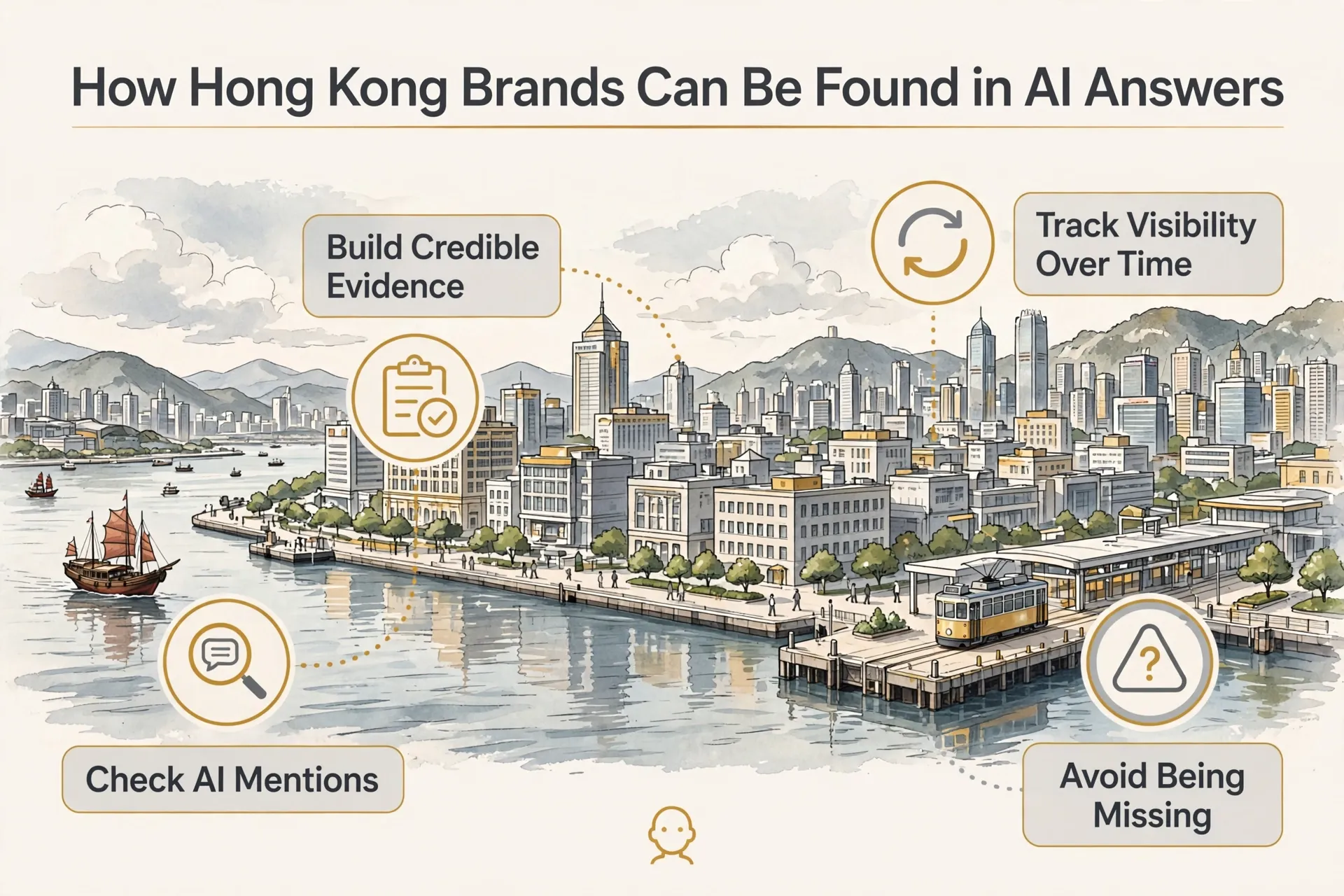
What Does It Mean for an AI Assistant to Recommend a Hong Kong Business?
An AI recommendation is not one single signal. It helps to separate a passing name-drop from a supported recommendation. We suggest businesses record three levels of visibility. The first is a mention, where the assistant names the brand but no source supports a substantive claim. The second is a supported citation, where a link or traceable source backs a specific claim about the service, location or specialty. The third is a complete answer, where the assistant states the correct service, Hong Kong location, a meaningful reason and a source that confirms those facts.
1. A Mention
The assistant names the brand in its answer, but no clickable source supports the recommendation. This shows the brand has some online presence, but it is weak evidence of trust.
2. A Supported Citation
The assistant names the brand and links to, or clearly traces, a source that backs a specific claim. This is a stronger signal because an independent source helps confirm the point.
3. A Complete Answer
The assistant states the correct service, Hong Kong location, a meaningful reason for recommendation and a supporting source. This is the most useful outcome to work towards.
How Can a Hong Kong Business Check Its Current AI Mentions?
A practical check does not require a large research budget. Start with real buyer questions rather than vague brand-name searches. In our team's practical work, we find that exact phrasing matters because assistants respond differently to the way a customer actually asks. Use questions from your own site search, reader emails or directory enquiry forms, and keep the wording as close as possible to how a customer asks.
Run the same question in a few assistants, in English and Traditional Chinese, using a fresh chat session each time. Do not paste your own website into the prompt, because the goal is to see what the assistant can find on its own. Save the prompt, date, tool and model label, the answer text, the order of brands, and every link or quoted claim. Then open each cited link and check whether it exists and actually supports the recommendation.
Step 1: Collect Real Buyer Questions
Use questions from your own site search, reader emails or directory enquiry forms. Keep the wording as close as possible to how a customer asks, including Cantonese phrasing or mixed English and Chinese.
Step 2: Run Comparable Prompts in Fresh Sessions
Use the same question in English and Traditional Chinese, and start a new chat for each test. Record the assistant name, model label and search mode because these details change often.
Step 3: Save the Answer and Its Sources
Capture the answer text, the first five brands, links, quoted claims and a screenshot. Do not rely on memory because answers can change between runs.
Step 4: Distinguish Mentions from Supported Citations
Check whether each brand is simply named or whether a clickable source supports a substantive claim. Treat these as different evidence levels.
Step 5: Test the Cited Links
Open every cited link and confirm that it exists and supports the stated claim. A generic source panel or homepage link is not enough.
Three Ways a Brand Can Appear in an AI Answer
| Visibility level | What you see | What it tells you | Next step |
|---|---|---|---|
| Mention | The assistant names the brand but no source supports a substantive claim | Some online presence, weak evidence | Add consistent details and independent coverage |
| Supported citation | The assistant names the brand and links to a source that confirms a specific claim | Stronger evidence of trust | Check the link and reinforce that source |
| Complete answer | The assistant states the service, location, reason and a supporting source | Most useful outcome | Maintain and monitor the evidence |
Why Might a Hong Kong Brand Be Missing from AI Answers?
If a brand is absent, the cause is usually not a penalty or a single bad review. It is more often an evidence problem. In our work with Hong Kong businesses, common patterns include inconsistent names, missing or thin bilingual pages, no independent corroboration, structured data that does not match visible content, and weak location or contact details.
A strong local digital marketing partner can help, but the evidence should come first. Our review of the top 10 best digital marketing companies in Hong Kong is a useful starting point if you want support.
1. Inconsistent Brand Names
The business uses a different English name, trading name and Chinese name across its website, directories and official records. Assistants may treat them as separate or uncertain entities.
2. Missing or Thin Bilingual Pages
The site has an English homepage but no useful Traditional Chinese service pages, or the Chinese page is only a short translation. For Hong Kong buyers who ask in Cantonese, that reduces the evidence available.
3. No Independent Corroboration
The only source is the brand's own website or social media account. Assistants often look for official details and independent publications to confirm accuracy.
4. Structured Data That Does Not Match Visible Content
Structured data can help, but only when it describes content that is actually visible on the page. Markup alone will not make a business recommendable.
5. Weak Location and Contact Details
A missing Hong Kong address, unclear service area or hidden contact page makes it harder for an assistant to place the business in the right geography.
What Evidence Helps AI Assistants Recommend a Hong Kong Business?
The most reliable path is to make your business easier to verify. That means aligning your public identity, local content and independent coverage rather than adding more promotional copy. We suggest focusing on five evidence types.
If you want specialist help, our guide to the top 10 best SEO agencies in Hong Kong can point you to local professionals who work on search, content and structured data.
1. Official and Registry Details
Keep your business registration and company information accurate and consistent. The Inland Revenue Department provides Business Registration Electronic Services, which forms part of the official record AI systems may consult.
2. Consistent English and Traditional Chinese Names
Use the same legal and trading names across your website, directories and public profiles. Link the English and Chinese versions clearly so an assistant can treat them as one entity.
3. Useful Service and Location Pages
Publish clear pages that explain what you do, where you serve and who you help. Hong Kong-specific details, such as districts like Central or Kowloon, make answers more relevant.
4. Independently Verifiable Coverage
Seek coverage in reputable local publications, trade directories or professional bodies. Assistants value sources that are not controlled by the brand itself.
5. Structured Data for Visible Content
Use structured data only to describe content that is already visible on the page. This can help assistants parse your name, address, services and operating details.
What to Record in a Basic AI Visibility Log
| Element | Why it matters | Example to record |
|---|---|---|
| Prompt | Keeps the test comparable | Full question in English and Traditional Chinese |
| Date and assistant | Tracks variability over time | 2 October 2026, assistant name and model label |
| Language and location | Captures local context | en-HK and zh-HK, Hong Kong location where available |
| Answer text | Preserves the exact result | Full answer or first five brands |
| Citations | Separates mentions from supported claims | Each link and the claim it supports |
How Should You Track AI Visibility Over Time?
A one-off answer is not proof of durable visibility. AI assistants can reformulate a question, retrieve different sources, or change the order of brands between runs. The sensible approach is to treat visibility as a repeated test with dated records. Keep a simple log that records the same elements each time, because this lets you compare like with like and notice whether a change came from your own website, a new press mention or the assistant's search behaviour.
1. Fix the Prompt and Language
Use the same buyer question in English and Traditional Chinese every time. Keep location setting to Hong Kong where the assistant allows it.
2. Record the Date, Tool and Model
Save the date, assistant name, model label and search mode. These details are essential because product labels and retrieval behaviour change frequently.
3. Review Changes with a Business Decision in Mind
Use the log to decide whether to continue, adjust or stop a particular visibility effort. Set your own documented criteria tied to accurate visibility and qualified enquiries, not a universal ranking promise.
What Should a Hong Kong Business Never Promise from AI Visibility Work?
AI visibility work is about improving the quality, consistency and accessibility of evidence. It is not a guarantee of a recommendation, a rank or a fixed answer position. Any provider who promises an AI ranking is overselling. We advise clients to report visibility as a repeated test with dated prompts, tools, languages and citations. A one-off screenshot is anecdotal. The goal is to increase the chance that an assistant can find and support the brand accurately, not to control the answer.
Evidence Signals That Strengthen AI Recommendations
| Evidence type | Where it comes from | Why it helps |
|---|---|---|
| Official and registry details | Inland Revenue Department and other public registers | Confirms the business exists and operates in Hong Kong |
| Consistent names | Website, directories and public profiles | Helps assistants link English and Chinese identities |
| Bilingual service pages | Your own site | Supports English and Traditional Chinese queries |
| Independent coverage | Reputable local publications and professional bodies | Provides third-party corroboration |
| Structured data | Visible page content | Makes details easier to parse |
What Privacy Rules Apply When You Use Real Buyer Questions?
Real buyer questions are useful, but they may contain personal data. Under the Personal Data (Privacy) Ordinance (PDPO), personal data must be collected lawfully and fairly, used only for a purpose directly related to the original purpose, kept no longer than necessary, and protected by appropriate security measures. The Office of the Privacy Commissioner for Personal Data publishes guidance on these principles.
Before you export or share a question log, run a privacy review of the actual fields, notices, purposes, retention, access controls, redactions and any sharing arrangement. Remove contact details, tracking strings and any information that identifies an individual. Keep only the wording that is needed for the test.
This is not a complete legal assessment, but it is a practical safeguard for Hong Kong businesses that want to use real customer language responsibly.
Conclusion
AI search visibility is not about forcing a brand into every answer. It is about removing the friction that stops an assistant from finding, understanding and supporting a Hong Kong business.
Start with real buyer questions, run comparable checks in English and Traditional Chinese, separate mentions from supported citations, and improve the evidence rather than adding promotional noise. Keep a dated log, respect the Personal Data (Privacy) Ordinance, and never accept a promise of a guaranteed AI ranking.
Hong Kong Brand helps local businesses promote themselves through editorial guides, directory profiles and practical business content. If you would like support improving how to appear in AI answers across Hong Kong search and AI assistants, explore our resources or contact us.
Review Your Hong Kong AI Visibility
Tell us about your business and current online presence. We will help you plan a practical AI visibility check and improve the evidence behind your brand.
Frequently Asked Questions
Start with real buyer questions, run them in a fresh session in English and Traditional Chinese, and save the answer plus all cited links. Do not paste your own website into the prompt.
A mention is when the assistant names a brand. A citation is when a clickable or traceable source supports a substantive claim about that brand. Mentions are weaker evidence than citations.
No. You can improve the consistency and accessibility of evidence, but no one can guarantee a recommendation, rank or fixed answer position. Treat any promise of an AI ranking with caution.
This often happens when the business has a strong English presence but missing or thin Traditional Chinese pages, inconsistent Chinese names, or less independent coverage in Chinese-language sources.
Record the prompt, date, assistant and model label, language, location, full answer text, brand order and every citation. Also open each cited link to confirm it supports the claim.
Hong Kong Brand
Author
We are dedicated to promoting and celebrating business brands in Hong Kong. We share the inspiring success stories of homegrown brands, highlighting their achievements and growth.