
When an SME owner shortlists accountants, much of the decision happens before the first phone call. A clear Hong Kong accounting firm profile can answer most fit questions in minutes. A vague profile simply delays the conversation.
Based on our team's practical experience helping clients explain their services, scope is often the first point needing clarification. "Monthly accounting" can mean transaction posting only. Yet the buyer may expect reconciliations, management accounts and a review call. Bundled service lines and unstated fee bases leave buyers guessing. They need certainty before making contact.
That matters because accounting support in Hong Kong touches statutory deadlines, audit appointments and tax filings. Buyers need to see service scope, fee basis, response expectations and verifiable credentials before committing to contact.
In this blog, we discuss the fields a good profile should cover. We also explain fee and audit wording, verifiable credentials, and questions that make choosing an accountant in Hong Kong easier.
What Service Lines Should a Hong Kong Accounting Firm Profile Separate?
When a buyer compares Hong Kong accountant services, the profiles that help most are the ones that split one vague "accounting" line into distinct, comparable fields. Here is how we suggest each field be defined so firms fill it in consistently.
1. Bookkeeping Services and Their Exact Scope
A useful profile can specify what its Hong Kong bookkeeping services actually cover: transaction capture, coding, bank and payment-platform reconciliation, and accounts receivable and payable handling. The stated frequency and cut-off matter too, because they tell you when your records will actually be usable.
2. Management Reporting Outputs and Timing
The profile should name the report pack — typically profit and loss, balance sheet, cash-flow information, aged receivables and payables, and budget or KPI comparisons. Consider stating delivery timing and whether a review meeting is included, so buyers can compare value rather than guess.
3. Year-End Accounts and Statutory Audit Work
This field should separate preparing year-end financial statements from statutory-audit work and from audit coordination. The difference determines who takes responsibility for your audit, so a profile that blurs it creates real confusion for buyers.
4. Tax Services, Described Precisely
Rather than implying a broad regulatory endorsement, a strong profile lists the work offered: profits-tax return preparation, tax computations, provisional-tax reviews, employer's returns, objections and advisory support. The Inland Revenue Department (IRD) does not endorse firms merely for preparing returns, and profiles should not suggest otherwise.
5. Cloud-Software Support, Named and Specific
"Cloud accounting available" tells a buyer very little. A stronger profile names each product and separates day-to-day bookkeeping use from migration, setup, integrations, training and ongoing support.
6. Sector Fit Backed by Real Complexity
Naming an industry is weaker than describing the operating complexity behind it — point-of-sale reconciliation for restaurants, payment gateways for e-commerce, or multi-currency work for trading businesses. That detail lets buyers judge whether the claimed experience is relevant to them.
How Should Hong Kong Accounting Firm Fees Be Presented?
Fee clarity is one of the first things we weigh when judging whether a profile will genuinely help an SME buyer. Hong Kong accounting firm fees are far easier to compare when the profile states the pricing basis rather than a bare "from" figure.
The profile should say whether charges are fixed monthly, fixed annual, hourly or per engagement, and what each option includes. Just as important is what sits outside the headline figure.
The assumptions worth spelling out include:
- monthly transaction volume
- number of bank accounts and entities
- payroll headcount, if the firm also quotes for outsourced payroll services in Hong Kong
- currencies handled
- whether catch-up or clean-up work is charged extra
- whether fees are quoted before disbursements
- the conditions under which the fee is repriced
Response expectations deserve a field of their own. As a transparency measure, a profile can state business hours, an acknowledgement target, a normal response target, an urgent contact route and a named service owner. Buyers then know what to expect before the first invoice, not after it.
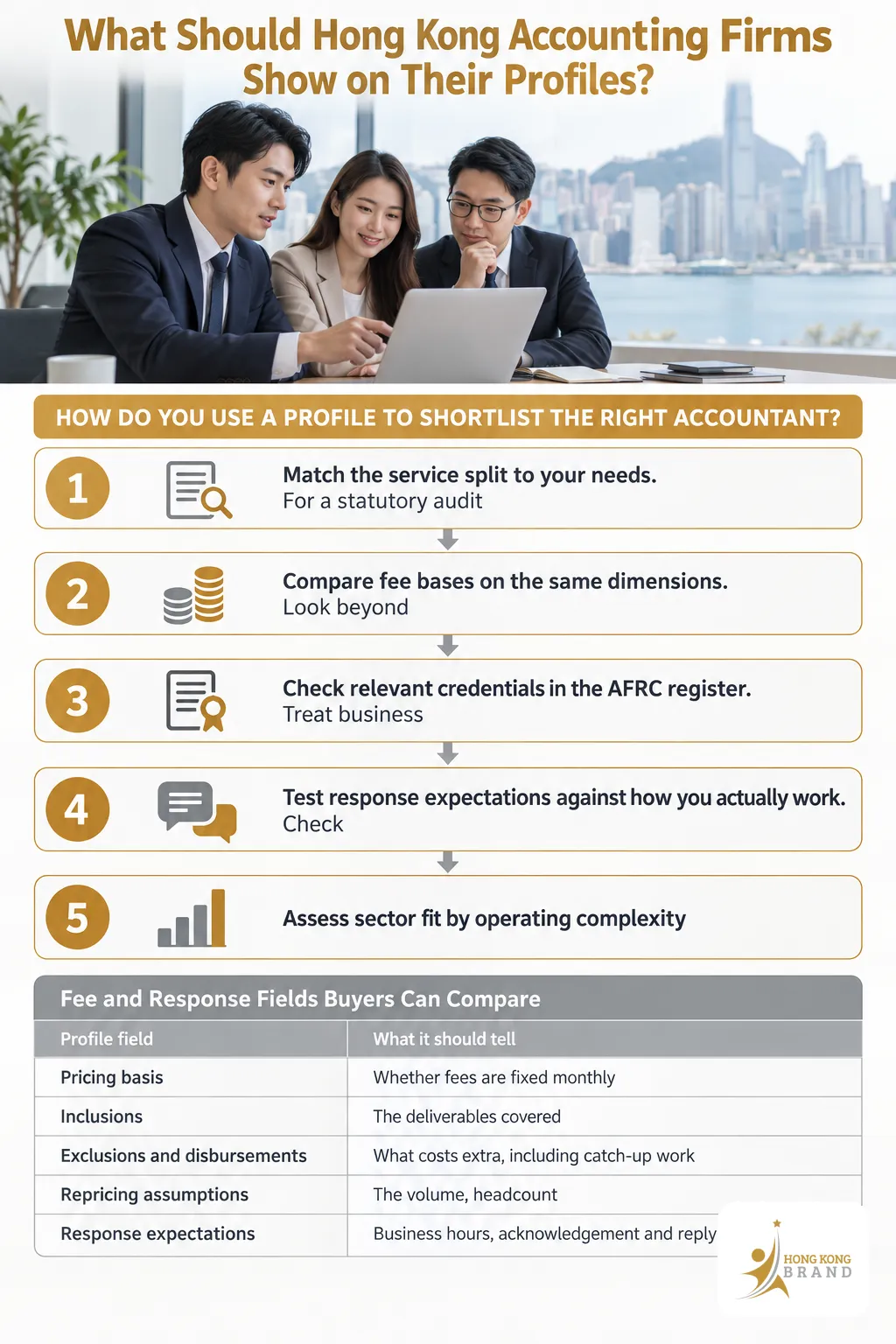
Fee and Response Fields Buyers Can Compare
| Profile field | What it should tell the buyer |
|---|---|
| Pricing basis | Whether fees are fixed monthly, fixed annual, hourly or per engagement |
| Inclusions | The deliverables covered, such as reconciliations, management reports and review meetings |
| Exclusions and disbursements | What costs extra, including catch-up work and out-of-pocket items |
| Repricing assumptions | The volume, headcount, currency or entity factors that change the fee |
| Response expectations | Business hours, acknowledgement and reply targets, urgent channel and service owner |
Who Can Legally Perform a Statutory Audit in Hong Kong?
Only an AFRC-registered CPA (practising), CPA firm or corporate practice may act as a company auditor. This is why a Hong Kong statutory-audit claim needs careful profile wording.
A firm that says it performs statutory audits should identify the responsible AFRC-registered practice unit. Buyers can then check that claim in the applicable AFRC register. A listing itself does not establish current eligibility, and registrations can change.
Audit coordination is a different service, and a useful profile should say so. The coordinator may prepare schedules, confirmations and query responses. An independent auditor is appointed separately. Coordination is entirely legitimate, but the profile should not blur who signs the audit report.
A firm claiming public interest entity (PIE) audit capability should identify its AFRC registered PIE-auditor status. This is a separate status for PIE engagements, not ordinary SME statutory audits.
Which Credentials Should You Check Before You Contact a Firm?
Not every registration means the same thing, and treating them as interchangeable is the fastest way to misjudge a firm. Membership of a professional body, a practising certificate, an AFRC-registered practice unit and PIE-auditor registration are four distinct statuses, each with its own register.
Business registration sits apart from all of these. Subject to statutory exemptions and the one-stop company and business registration arrangements, businesses must meet the applicable business-registration requirements, generally within one month of commencement. But the IRD is clear that the certificate is not a licence to trade, so a business registration number alone says nothing about professional accounting credentials.
On tax filings, IRD guidance confirms you may engage a service provider to furnish your profits-tax return on your behalf, provided the prescribed written confirmation is in place. Engaging a provider does not relieve you, the taxpayer, of the filing obligation. How this applies to your own filing mode and tax year is something your own tax adviser should confirm.
Basic checks include:
- the named professional and the practice unit behind each regulated claim
- the register that matches the specific claim being made
- the date the profile was last updated, since credentials lapse and registrations change
Audit Claims and How a Buyer Can Verify Them
| Claim on the profile | What it should say | How you check it |
|---|---|---|
| Performs statutory audits | Names the responsible AFRC-registered CPA firm, corporate practice or CPA (practising) | The applicable AFRC public register |
| Audit coordination | States that an independent auditor is appointed separately, and lists the schedules and responses prepared | The appointed auditor's own registration |
| PIE audit capability | Identifies registration with AFRC as a registered PIE auditor | The AFRC PIE auditor register |
| No audit service offered | Says so plainly and explains how year-end accounts are prepared | Not applicable |
Where Should a Directory Draw the Line Between Facts, Claims and Recommendations?
This is Hong Kong Brand editorial guidance, based on our team's practical experience helping clients present services clearly. A trustworthy profile should keep three layers visibly apart.
1. Verifiable Facts a Firm Can State
These include the legal entity name, office location and establishment date. They can also include named professionals, current registrations, languages, software credentials and team size as of a stated date. Team size needs a definition covering employees, partners and contractors. That makes the figure meaningful.
2. Client-Facing Claims That Need Evidence
Client-facing claims should be backed by defined records and a stated period. Otherwise, they should be toned down. Outcome claims need a baseline, the work performed and client permission. They should not suggest that every client will see the same result.
3. Editorial Recommendations That Belong to the Publisher
A "recommended" badge is the publisher's conclusion, not something a firm supplies or purchases. The publisher should state the selection criteria and review date. It should disclose any commercial relationship. A firm should never present the badge as regulatory approval.
Professional Statuses and Where to Verify Them
| Status or claim | What it means for you | Where to verify |
|---|---|---|
| CPA (practising) | The individual may accept audit appointments | AFRC register of practising CPAs |
| CPA firm or corporate practice | The practice unit is registered with AFRC and can take responsibility for audits | AFRC register of practice units |
| Registered PIE auditor | The unit may audit listed-entity financial statements | AFRC PIE auditor register |
| Business registration | Generally a legal requirement to carry on business in Hong Kong, subject to statutory exemptions, and not a professional licence | IRD |
| Tax-return preparation | A service engagement, not an approval of the firm | Your engagement letter and IRD guidance |
How Do You Use a Profile to Shortlist the Right Accountant?
Once you know which fields matter, the comparison becomes quick. Follow a fixed order to produce a confident shortlist before an exploratory meeting.
- Match the service split to your needs. For a statutory audit, confirm whether the firm performs it through an eligible practice unit. Alternatively, confirm that it coordinates with a separately appointed auditor.
- Compare fee bases on the same dimensions. Look beyond the headline figure to inclusions, exclusions, disbursements and repricing assumptions.
- Check relevant credentials in the AFRC register. Treat business registration as a legal requirement, not professional accreditation.
- Test response expectations against how you actually work. Check the urgent contact route and who owns your account.
- Assess sector fit by operating complexity, not by industry name alone.
These checks help Hong Kong SMEs compare firms quickly. At Hong Kong Brand, we design our Best in Hong Kong guides to surface these details for busy owners.
Conclusion
A strong Hong Kong accounting firm profile should separate the information buyers need:
- bookkeeping scope
- management reporting
- year-end accounts
- statutory-audit work or coordination
- tax services
- cloud-software support
- fees and response expectations
Credentials should be verifiable in the relevant AFRC registers. Business-registration information can be checked through the IRD. Clear profiles also separate firm-supplied facts, substantiated client claims and editorial recommendations.
For accounting firms, publishing these fields turns casual browsers into better-matched enquiries. For SME owners, it turns a frustrating search into a ten-minute comparison.
Through our directory, Best in Hong Kong guides and practical blog, we help clients explain what they offer. We connect local firms with the owners who need them. If you would like your firm's story told properly, we would love to hear from you.
Get Your Firm Noticed
Hong Kong Brand helps local accounting firms present their services clearly and reach the Hong Kong SMEs that need them.
Frequently Asked Questions
No. Business registration is a legal requirement for carrying on business in Hong Kong, and the IRD states clearly that the certificate is not a licence to trade. Professional claims should be checked against the relevant AFRC register instead.
No. Only a CPA (practising), CPA firm or corporate practice registered with AFRC may hold an appointment or act as a company auditor. Other firms may prepare schedules and coordinate with a separately appointed independent auditor.
The pricing basis, what is included, what is excluded, whether disbursements are extra, and the assumptions — such as transaction volume, headcount and entity count — that trigger a repricing.
No. IRD guidance confirms that engaging a service provider does not relieve the taxpayer of the filing obligation, and the provider needs the prescribed written confirmation to furnish the return on your behalf.
No. PIE-auditor registration with AFRC relates to listed-entity engagements. A firm claiming PIE audit capability should identify that registration, but SME audits do not require it.

Hong Kong Brand
Author
We are dedicated to promoting and celebrating business brands in Hong Kong. We share the inspiring success stories of homegrown brands, highlighting their achievements and growth.