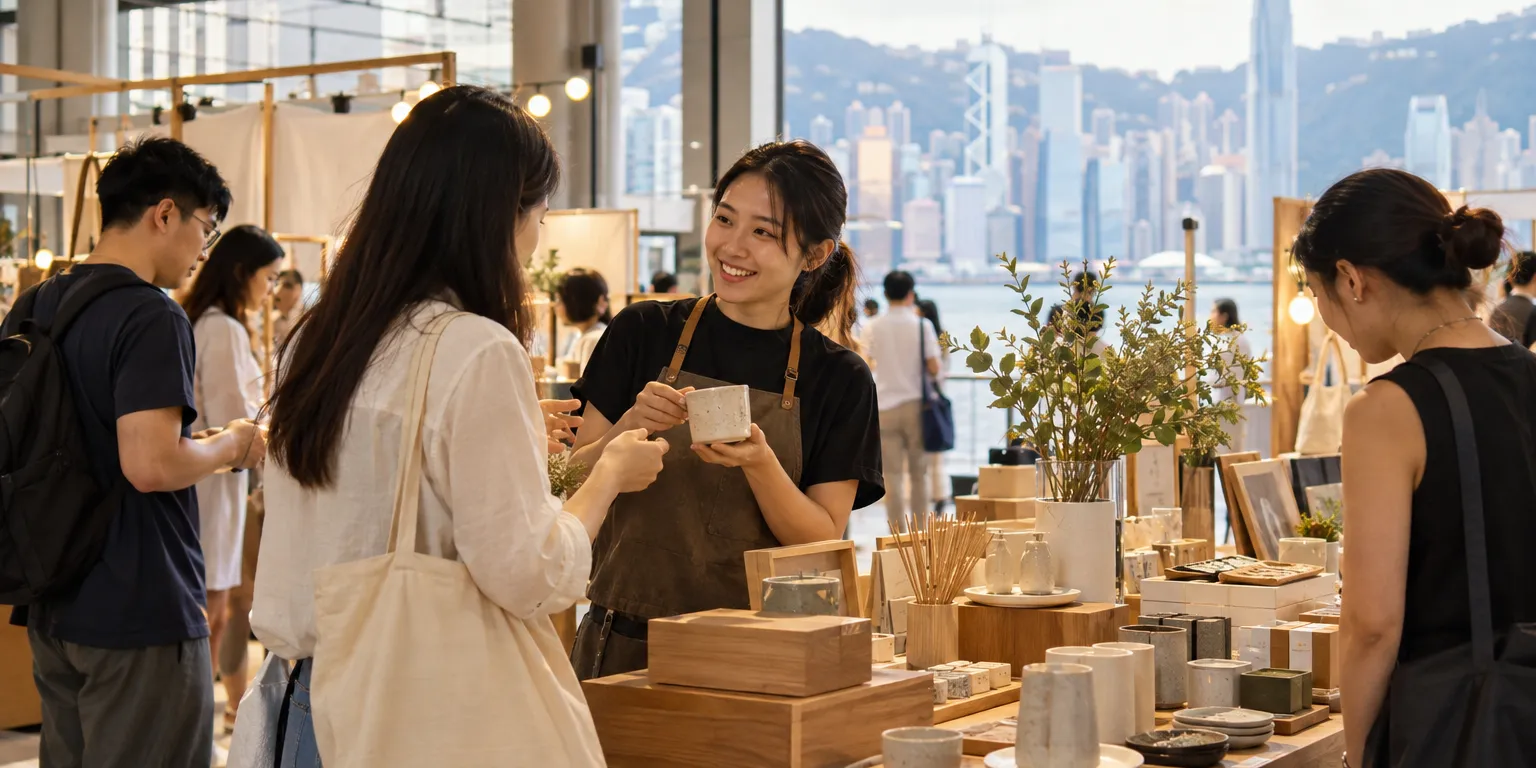
A Grade III historic building on Queen's Road Central has, since its reopening in August 2021, become an unexpected stage for HK branding. It is a place where young local labels meet Central's foot traffic without signing a long lease.
Central Market sits right beside the Central-Mid-Levels Escalator. It lies between Queen's Road Central and Des Voeux Road Central. Its mix of shops, eateries and event spaces draws office workers, tourists and SoHo regulars throughout the day. For a small brand, that concentration of passers-by is normally the most expensive thing in Hong Kong retail.
Pop-ups change the arithmetic. Instead of committing to years of rent in one of the world's priciest retail districts, you can rent a short-term presence. You can test your products in person. Shoppers can meet the people behind the brand.
In this blog, we discuss why Central Market suits pop-up retail. We also cover what the Inland Revenue Department expects before you trade. You will learn how to plan a pop-up that builds real brand exposure in Hong Kong. We share how to measure whether it worked.
Why Is Central Market Such a Strong Stage for Hong Kong Branding?
Central Market offers something most Hong Kong venues cannot: heritage character combined with short-term formats in the middle of the city's core business district. A brand that could never justify a permanent Central flagship can still appear there, be photographed there and be discovered there.
The building's revitalisation preserved its market-era structure while adding modern retail and cultural spaces, which gives your displays a backdrop with genuine story appeal. Here is what that means in practice.
1. Heritage that gives your story depth
A restored historic structure photographs beautifully and gives journalists and customers an immediate angle. Your pop-up is not just another mall stall; it sits inside a piece of the city's living history.
2. Footfall you could not buy alone
Central's daytime office crowd, escalator traffic and visitor stream may pass the venue daily. This potential reach can reduce the advertising budget an emerging label would otherwise need. Actual exposure depends on your unit, opening hours and season.
3. Short leases that match short goals
Short-term formats let you launch a collection, test a product line or run a seasonal stall for days or weeks rather than years. You can learn quickly, adjust and return when the time is right.
4. Programming that draws new crowds
Talks, exhibitions and cultural events hosted at the venue can draw visitors who come first for the experience. These visitors may discover brands along the way. The result is potential exposure beyond regular shoppers.
What Can a Pop-Up Do for Your Hong Kong Business Brand?
A pop-up turns passive awareness into first-hand memory: people touch the product, talk to your team and leave with a reason to follow you. That conversion from stranger to supporter is the core value, and sales are almost a bonus.
Four effects matter most for a growing Hong Kong business brand.
1. Real-world product testing
You watch which items people pick up first, which prices make them hesitate and which questions they repeat. A week of face-to-face feedback can replace months of guesswork about your range.
2. Content that outlives the lease
A photogenic space against a heritage backdrop yields weeks of social content, and that content keeps working for your brand long after the pop-up ends.
3. Trust built face-to-face
A human explanation of how your product is made or sourced beats any product page. This matters especially for premium, handmade or specialised goods where story drives the purchase.
4. A timely hook for media attention
A launch, a limited run or a first physical presence gives local media something concrete to cover. Our guide to the top 10 best PR firms in Hong Kong is a useful starting point if you plan to work with an agency on that outreach.
Central Market Pop-Ups vs Conventional Retail Leases
| Factor | Pop-up at Central Market | Conventional retail lease |
|---|---|---|
| Typical commitment | Days to a few months | One to three years or more |
| Upfront cost | Short-term rental plus light fit-out | Deposit, premium and full shopfront fit-out |
| Fit-out approach | Light, reversible displays | Permanent fixtures usually required |
| Audience reach | Heritage-venue footfall in Central | Depends on street or mall position |
| Best suited to | Testing, launches and content | Established, scalable retail |
What Do You Need to Know About Business Registration for a Pop-Up?
Sole proprietorships, partnerships, unincorporated bodies, non-Hong Kong companies and branch businesses must apply for business registration within one month of commencing business; Hong Kong companies register through the one-stop incorporation process. For a short pop-up, apply as soon as the business has commenced and within one month; the IRD will not accept an application before it has commenced.
According to the Inland Revenue Department, sole proprietorships, partnerships, unincorporated bodies, non-Hong Kong companies and branch businesses must apply for business registration within one month of commencement; Hong Kong companies use one-stop registration.
- sole proprietors
- partnerships
- companies
Applications require the prescribed form and payment; proof-of-identity documents are required for most applicants, but not for a branch-registration application.
Under the Business Registration Ordinance (Cap. 310), failing to register is an offence. A conviction carries a fine of HK$5,000 and up to one year's imprisonment. If you apply more than 12 months after commencing business, you must also pay fees and levies for the back years.
For certificates with a commencement date from 1 April 2026 to 31 March 2027, the official business registration fee and levy table sets out the charges below. The levy funds the Protection of Wages on Insolvency Fund, so it applies even when other costs feel negotiable.
The IRD issues certificates within 30 minutes for in-person applications. It issues certificates within 2 working days for applications submitted by post or through GovHK.
If your turnover is very small, you may apply for exemption from the registration fee and levy. The exemption thresholds are average monthly sales of HK$10,000 or below for service businesses, and HK$30,000 or below for other businesses. Exemption is granted one year at a time.
Depending on what you sell, you may also need:
- product-specific licences
- venue approval
- public-liability insurance
Business Registration Fees and Levies (1 April 2026 to 31 March 2027)
| Certificate type | Registration fee | Levy | Total |
|---|---|---|---|
| 1-year business registration certificate | HK$2,200 | HK$150 | HK$2,350 |
| 3-year business registration certificate | HK$5,720 | HK$450 | HK$6,170 |
| 1-year branch registration certificate | HK$80 | HK$150 | HK$230 |
How Do You Plan a Pop-Up That Maximises Branding Exposure in Hong Kong?
Start with one measurable goal, then design the space, staffing and follow-up around it. A pop-up without a clear objective tends to become an expensive photo opportunity rather than a marketing asset.
The five steps below reflect what we see working for local labels testing physical retail for the first time.
Before you commit, contact Central Market directly to confirm current short-term space availability, permitted product categories and any venue requirements for pop-up tenants.
Step 1: Set a single measurable goal
Choose one number to chase, such as 500 new followers, 300 trial sign-ups or a target sales figure per trading day. One goal keeps every later decision honest.
Step 2: Design the space for photographs
Plan clear sightlines, strong lighting and one memorable brand moment that visitors will want to capture. If the space photographs well, your customers create marketing content for you.
Step 3: Staff for conversations, not just sales
Brief your hosts on the founding story and product details so every exchange builds the relationship. The best pop-up teams sell the brand first and the product second.
Step 4: Capture content every day
Shoot behind-the-scenes moments, customer interactions and restocking scenes throughout the run. Daily content gives your channels momentum that continues after closing day.
Step 5: Collect permission-based contact details
Offer a QR-code opt-in for updates, a small gift or a members' preview. Turning visitors into an owned audience is often the most valuable thing you take home.
Sample Pop-Up Budget Framework
| Budget line | Indicative share | What it covers |
|---|---|---|
| Space rental | 40–50% | Short-term fee for the unit or event space |
| Fit-out and props | 20–25% | Reusable displays, signage and lighting |
| Staffing | 15–20% | Trained hosts who can tell your brand story |
| Marketing | 10–15% | Social content and local media outreach |
| Contingency | 5–10% | Buffer for stock replenishment and extras |
How Do You Measure Whether the Pop-Up Worked?
Compare pre-set numbers against actuals rather than relying on gut feel. Decide your metrics before opening day, then review them within a week of closing so the lessons stay fresh.
Track these indicators across the run:
- Daily sales and average transaction value
- New followers and email sign-ups collected on site
- Reach and engagement on pop-up content
- Media mentions or influencer features
- Wholesale, stockist or collaboration enquiries received
- Repeat contacts from visitors after the pop-up ends
Those numbers tell you what to do next. Strong in-person sales may justify a longer lease. Strong social growth may point you to online channels instead. Our guide to Hong Kong online retail channels offers a look at where Hong Kong shoppers already spend online.
We built this platform because we believe local labels deserve a bigger stage, and you can read more about who we are and why we do this work. If you would like a second opinion on your pop-up plan before you commit, reach out to our team.
Conclusion
Central Market gives local labels what they need most: heritage character, Central footfall and short commitments that make experimentation affordable. Plan the legal side:
- Register with the IRD within one month of starting to trade.
- Budget for the 2026-27 fee of HK$2,350 on a one-year certificate.
- Check the exemption thresholds if your turnover is small.
Set one measurable goal before opening day. Design for photographs. Staff for conversations. Capture both content and contact details while the doors are open. Measured honestly, even a short pop-up can deliver far more than sales—it can hand you an audience, a content library and proof of demand.
At Hong Kong Brand, we help local companies tell their stories and find their audience. We do this through Best in Hong Kong guides, our business directory and our events listings. If a pop-up is part of your plan for Hong Kong branding this year, we would love to help you make the most of the moment.
Ready to Give Your Brand a Central Stage?
Share your pop-up story with our community, list your business in our directory, or ask us how local brands are using short-term retail to grow.
Frequently Asked Questions
Yes. The IRD requires sole proprietors, partnerships and companies to apply for business registration within one month of commencing business, regardless of how short the trading period is. Failure to register can attract a fine of HK$5,000 and up to one year's imprisonment.
For the period from 1 April 2026 to 31 March 2027, a one-year business registration certificate costs HK$2,350 in total — a HK$2,200 registration fee plus a HK$150 levy for the Protection of Wages on Insolvency Fund.
Possibly. You can apply for exemption if your average monthly sales do not exceed HK$10,000 for businesses mainly selling services, or HK$30,000 for other businesses. Exemption is granted one year at a time, and you must reapply for each subsequent year.
There is no fixed rule, but a run of one to four weeks is a sensible first test. It is long enough to gather customer feedback and content, yet short enough to control cost and refine your approach before any longer commitment.
No. Other revitalised buildings and malls across Hong Kong also run short-term retail programmes. Central Market's particular strengths are its heritage character, its position beside the Central-Mid-Levels Escalator and its steady mix of office workers, tourists and local visitors.

Hong Kong Brand
Author
We are dedicated to promoting and celebrating business brands in Hong Kong. We share the inspiring success stories of homegrown brands, highlighting their achievements and growth.