
According to the Companies Registry, a local limited company receives a Certificate of Incorporation and a Business Registration Certificate once an incorporation application is approved. That official record is useful, but it does not tell a publisher when the business first traded or what decision changed its direction.
Hong Kong Brand publishes stories about homegrown businesses and their journeys. We ask a practical editorial question: does the story show a genuine Hong Kong connection? Does it share a specific experience another local founder can learn from?
The trouble is that many founders prepare a biography or a list of capabilities. Editors are not looking for a brochure. They are looking for a clear angle, access to the founder and facts that survive checking.
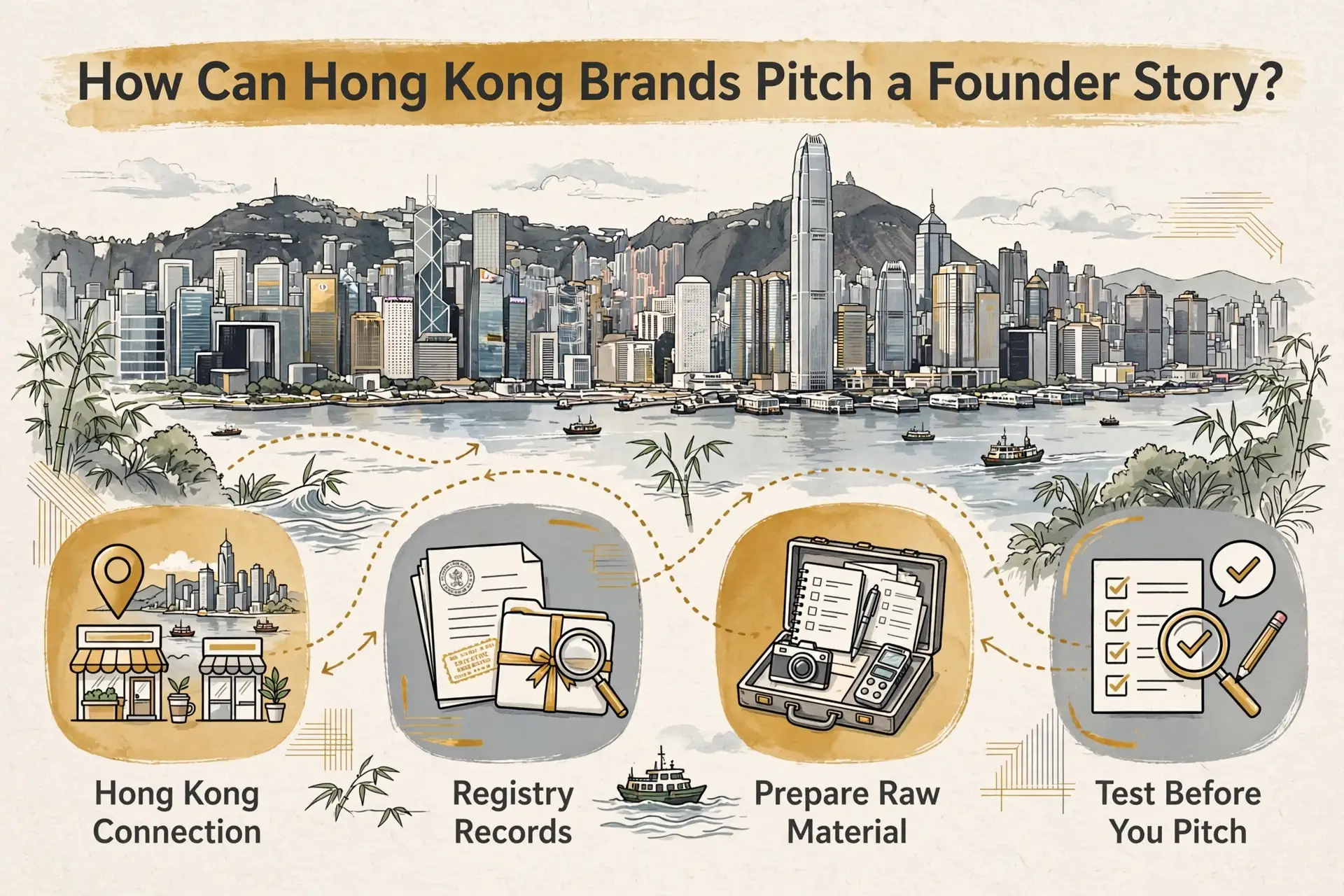
This article explains how to turn genuine business experience into a founder story that a local business or lifestyle publisher can use. In this blog, we discuss what editors look for, what makes a pitch too early, and how to prepare a submission that is easy to verify.
What Do Hong Kong Editors Look for in a Founder Story?
A usable founder story shows a clear Hong Kong connection and a specific decision or turning point. Its facts should be checked rather than presented as a polished corporate biography. Hong Kong Brand describes itself as a directory and discovery portal that shares homegrown-brand success stories and milestones; you can read more on our about us page. This is editorial guidance, not a documented acceptance standard, and the homepage alone does not set out a submission process.
The most usable submissions are short on adjectives and long on observable experience. The same material that works in a sales brochure often fails here because it describes a product without explaining a choice.
1. A genuine Hong Kong connection
A pitch should explain how the business actually operates in Hong Kong rather than only list an address. This can include a local customer base, a district-level presence, local hiring or a decision tied to a specific Hong Kong market condition.
2. One specific experience or turning point
The story should centre on a decision, obstacle, lesson or turning point that changed the business. A founder story is less useful when it reads as a list of awards, ambitions or services.
3. Claims that can be dated and inspected
Material facts should be supportable with dated, inspectable sources. Founders should be ready to say when something happened and what primary record shows it.
What Makes a Founder Story Pitch Too Early or Too Promotional?
A pitch usually looks premature when it contains only a launch, incorporation, fundraising plan or forecast and lacks observable customer experience, a real decision or verifiable evidence. Editors can repair rough English, but they cannot repair absent facts, an indistinct angle or claims the founder cannot substantiate.
Promotional copy often hides the same underlying gap. If a paragraph could be pasted unchanged into a sales brochure, it is not yet a founder story.
1. Launch announcements without customer experience
Announcing that a business has been incorporated or that a founder has an idea rarely gives a reader a lesson. The story becomes useful after something has happened that a founder can describe specifically.
2. Future milestones that have not happened
A planned shop opening, funding round or expansion is not evidence of a decision with consequences. It is better to wait until the milestone has occurred and its result can be shown.
3. Broad superlatives and undefined market claims
Terms such as leading, first or number one often arrive without a defined market, period or evidence. Replace them with defined, supportable facts or leave them out.
4. A service list with no founder decision or lesson
A list of capabilities tells an editor what the company does, not why a founder chose a difficult path. The detail that matters is the decision that led to that service or the mistake that changed it.
Early Founder Story Pitch vs Publishable Pitch
| Signal | Premature or promotional | Publishable alternative |
|---|---|---|
| Milestone | A future launch, funding plan or forecast that has not happened | A decision already made with an observable result |
| Claim | Leading, first or number one with no defined market | A dated claim with a clear baseline and source |
| Content | Awards, ambitions and a list of services | One decision, obstacle or lesson another founder can use |
| Evidence | Unnamed awards or growth without a calculation period | Award year, category, awarding body and inspectable support |
What Can Hong Kong Company Records Prove in a Founder Story?
For a local limited company, the Companies Registry issues two documents after an approved incorporation application. They are a Certificate of Incorporation and a Business Registration Certificate. The Inland Revenue Department (IRD) explains that a valid Business Registration Certificate shows a date of payment and remains valid until its printed expiry date.
Treat these records as background identity evidence rather than proof of an individual company's operating history. A Certificate of Incorporation confirms the legal creation of the company, not the day it first sold anything or the scale of its business. A Business Registration Certificate can support the registration period. It should sit alongside dated evidence of first trading, such as an invoice, lease, archived page or contemporary announcement. This is an interpretation rather than a universal evidential rule, because much depends on the exact claim.
Hong Kong Company Records and What They Show
| Record | What it can support | What it does not prove on its own |
|---|---|---|
| Certificate of Incorporation | Legal creation of a local limited company | First trading date, trading volume or product availability |
| Business Registration Certificate | Registration period and identity until the printed expiry date | Launch date, performance or active trading by itself |
| Dated invoice, lease or archived page | Activity at a specific point in time | That the activity continued unchanged or grew |
What Should a Founder Prepare Before Contacting a Publisher?
Before you write the pitch, gather the raw material that lets an editor verify the story and bring it to life. These are examples of potentially useful preparation rather than an exhaustive checklist or a fixed Hong Kong Brand intake standard. Some founders choose to work with a public relations specialist. If you are considering outside help, our Hong Kong PR firm list can help you compare local specialists.
1. An attributable interview or specific quotes
Prepare a short interview with the founder or specific quotes that reveal a decision, mistake or lesson. Public-relations-written corporate statements often describe the brand rather than explain a founder choice.
2. A concise factual summary and dated milestone chronology
Have a plain summary of what the business does and a dated list of the few milestones that actually changed the company. Keep the chronology tight enough that an editor can spot the story angle quickly.
3. Support for major claims
For each material claim, prepare the source that would let a fact-checker confirm it. This can include official records, contemporaneous announcements, product information, partner confirmations, calculation notes or image files.
4. Image files with captions, credits and permission
Prepare original-resolution portraits and images that show the product, service or premises in use. A logo alone is not a substitute for editorial photography, and identifiable people may require appropriate permission.
5. A responsive fact-check contact
Name one person who can answer follow-up questions promptly. Delays often come from missing image clearance or unavailable founders rather than from the story idea itself.
Which Founder Story Angles Usually Work Better for a Hong Kong Audience?
The most useful founder stories show a business-changing decision and its consequences, not a simple list of awards, ambitions or brand claims. The following are possible story angles rather than proven predictors of publication.
1. A change prompted by customers
Show the feedback, complaint or observation that led the founder to alter the offer. The useful detail is the decision and what changed as a result.
2. A documented operational challenge
Describe a lease, supply, staffing or cash-flow shock with a dated event and a clear consequence. Avoid vague statements such as we overcame challenges.
3. A channel, location or succession decision
Explain why the business opened or closed a location, moved from online to physical retail, or handed control to a new generation. The reason matters more than the announcement.
4. A product redesign or recall
A before-and-after account with the reason for the change is more instructive than a new feature list. Show what prompted the redesign and what the founder learned.
5. A properly measured community initiative
State what was delivered, when, to whom and how it was counted. Measured community work is more credible than broad claims of helping the community.
Founder Story Angles and the Evidence They Need
| Angle | What a publisher wants to see | What weakens it |
|---|---|---|
| Customer-driven change | Specific feedback that led to a named change | A vague claim that the business listens to customers |
| Operational challenge | Dated event, decision and consequence | Unexplained resilience without detail |
| Channel, location or succession | Reason, trade-off and result | A bare announcement of a new shop or generation |
| Product redesign | Before-and-after detail with a reason | New features with no story |
| Community initiative | What was delivered, when and how it was counted | Helped the community with no method |
How Should You Test Your Founder Story Pitch Before You Send It?
The final test is short: if the paragraph could be pasted unchanged into a sales brochure, it is not yet a founder story. Before pitching again, a founder can document one meaningful decision, gather primary evidence, secure image rights, define claims precisely and state the reader takeaway in one sentence.
A practical self-check includes:
- Can you name one specific decision, obstacle or turning point?
- Can you date the facts and point to an inspectable source?
- Do the images have clear ownership, captions and permission?
- Would another Hong Kong founder learn something useful from this?
When the angle, evidence and image rights are in place, you can start a conversation through the Hong Kong Brand contact page.
Conclusion
Strong founder story pitches are not louder marketing. They are a clear Hong Kong connection, a specific decision or turning point, and dated evidence that can be checked. Before contacting us, distinguish the legal incorporation date from the date trading began. Prepare images and attributable quotes, then run the brochure test on your copy.
Hong Kong Brand exists to help homegrown companies share these journeys with the local business community. If your story is ready, we would be glad to hear how a particular decision changed your business.
When you are ready to pitch a founder story in Hong Kong, focus on one real experience, one clear angle and the evidence that supports it. That is what turns an unfocused company description into a useful founder story.
Ready to shape your founder story?
Tell us about the Hong Kong business decision, challenge or turning point that changed your company. Our team can help you turn it into a clear and verifiable story.
Frequently Asked Questions
You do not necessarily need to be a registered Hong Kong business, but you do need a genuine Hong Kong connection, and official records can help support your identity. This is editorial guidance rather than a documented mandatory rule.
No. It can support the registration period, but a publisher will usually also look for dated evidence such as invoices, leases, archived pages or contemporaneous announcements.
A launch announcement alone is often premature. Document one meaningful decision or customer experience first, then frame a story around that decision and its result.
You can pitch, but be prepared for delays. Image clearance often causes delays, so prepare original-resolution files, captions, credits and permission before submission, especially if identifiable people appear.
It is not necessary, but founders who want support can compare local specialists. Founder quotes should still be attributable and reveal a real decision or lesson.

Hong Kong Brand
Author
We are dedicated to promoting and celebrating business brands in Hong Kong. We share the inspiring success stories of homegrown brands, highlighting their achievements and growth.