
Two launch proposals land in your inbox the same week, and the lower fee looks like the obvious winner — until you notice each firm is quoting a different scope.
Before you compare PR agency proposals in Hong Kong, you need to line up what each agency is actually selling, not just the price on the front page. The proposal that looks expensive may be the one that includes the work your launch genuinely needs.
A brand launch in Hong Kong usually touches two media markets at once. Traditional Chinese outlets reach local consumer and lifestyle desks, while English-language media reach an international and business audience. A quotation that covers only one of those workstreams is not the same product, whatever the headline number suggests.
Choosing a public relations (PR) partner is one of the few launch decisions you fully control. Editors decide whether an earned story runs. You decide who pitches, in which language and what counts as delivered. In this blog, we explain how our editorial team compares proposals. We normalise scope, check bilingual outreach, decode coverage numbers and read the fine print. We also discuss client responsibilities and the choice between a project, a retainer and in-house support.
How Can You Compare PR Agency Proposals Hong Kong Agencies Submit?
When you compare PR agency proposals in Hong Kong, start with the same written brief. Give each agency the same launch window, target audiences, language goals, coverage ambitions and budget band, and ask each one to price that brief. Without a shared brief, you are comparing documents rather than offers.
Next, normalise the scope before the fee. List what each proposal includes and — more importantly — what it leaves out. Check whether the base price excludes photography, event operations, sample fulfilment, paid distribution or sponsored features. Add realistic allowances for those items before judging which quotation is cheaper.
A proposal can look inexpensive because essential work sits in optional add-ons. This is our team's general buying guidance, not a verdict on any particular firm. In our judgement, matching scope provides the fairest basis for comparing fees.
If your launch reaches beyond Hong Kong — into the Chinese Mainland or other target markets — some promotion costs may attract government support. The Dedicated Fund on Branding, Upgrading and Domestic Sales (BUD Fund) supports eligible non-listed Hong Kong enterprises. According to the Trade and Industry Department, its cumulative ceiling is HK$7 million per enterprise (as at November 2026). The SME Export Marketing Fund was consolidated into the BUD Fund on 1 July 2026. Confirm current terms on the department's website before budgeting around them, because schemes and ceilings change.
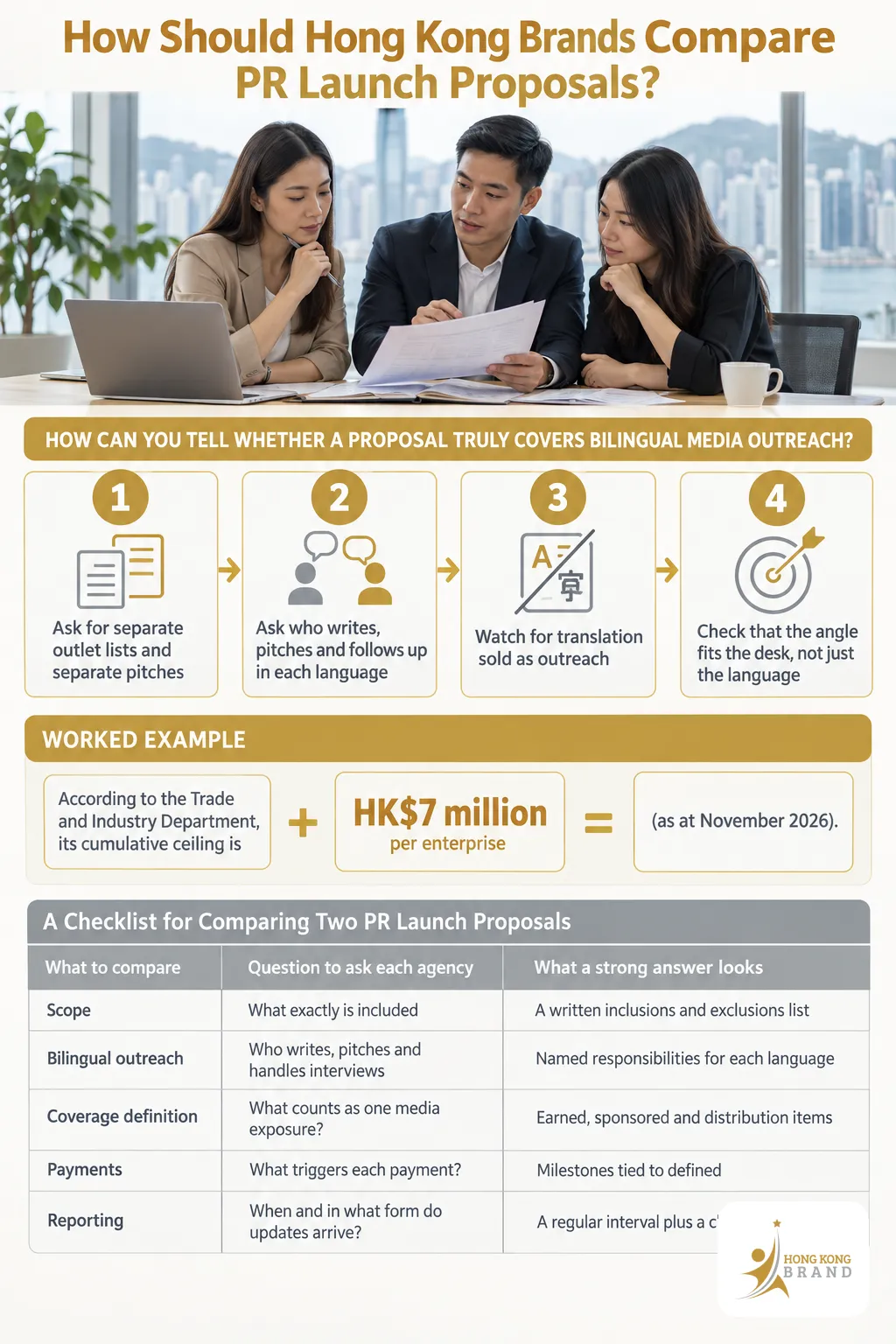
How Can You Tell Whether a Proposal Truly Covers Bilingual Media Outreach?
If you want to reach both language audiences in Hong Kong, check the scope for each. Our editorial team treats Traditional Chinese and English outreach as two separate workstreams and checks each one independently. Translated materials alone do not establish that an agency will pitch Chinese-language desks.
1. Ask for separate outlet lists and separate pitches
Request the named outlets, relevant desks and proposed angles for each language. A Hong Kong retail-growth story may suit an English-language business editor, while a hands-on product demonstration may suit a Chinese-language lifestyle desk. An identical translated pitch wastes that distinction.
2. Ask who writes, pitches and follows up in each language
Outreach depends on people, not documents. Ask which team member prepares your founder for interviews in each language, who chases follow-ups, and get those responsibilities written into the scope before signing.
3. Watch for translation sold as outreach
Imagine a founder who buys translated materials but not the Chinese-language outreach add-on. The launch pack looks bilingual, yet nobody has pitched Chinese-language desks at all. The reverse gap is also possible: an agency lists English-language outlets but assigns no one to prepare the founder or follow up effectively in English.
4. Check that the angle fits the desk, not just the language
Strong storytelling in branding adapts the angle to the editor, not merely the language. The same launch can carry a business narrative in one language and a practical lifestyle narrative in the other — two different pitches, not one translation.
Earned, Sponsored and Distributed Coverage at a Glance
| Coverage type | How it happens | How it should appear in a report | What it signals to readers |
|---|---|---|---|
| Earned article | A journalist independently researches and reports the story, with or without an interview | Listed as earned, with date, language and URL, and interview status recorded | Independent third-party validation |
| Sponsored feature | You pay a publisher for an agreed article and promotion | Labelled as paid, with spend and payment recipient shown | Reach you bought, not validation |
| Distribution pickup | Your release is circulated and hosted, often near-verbatim, on many sites | Grouped under distribution, never counted as earned stories | Visibility, but not editorial endorsement |
Why Do Media Exposure Numbers Mean Different Things in Proposals?
Coverage counts are the easiest numbers to compare and the easiest to misread. Before weighing any figure, ask the agency to define the unit being counted.
Our editorial rule is to keep three categories separate: independently earned articles, sponsored features, and press-release distribution pickups. An earned article is independently reported without payment for publication; it need not involve an interview. A paid feature stays commercial even when it reads like a profile. A release circulated through a distribution network may appear on many websites, but those near-identical copies are not independent endorsements.
Ask for every reported URL to be classified — with publication date, language, whether payment changed hands, and whether an interview actually happened. Keep pitched-but-unconfirmed outlets in a separate pipeline column. A report that folds the pipeline into delivered results inflates progress without adding coverage.
In practice, copy similarity alone does not settle the classification. An earned article can borrow facts from your release and may have no publication invoice. Check available booking records, invoices and editorial correspondence to understand each item's status.
Which Fine Print Should You Read Before Signing a Launch Proposal?
The contract decides what happens when reality diverges from the plan, so the fine print deserves as much attention as the strategy deck. These are the clauses our team looks at first, whichever agency is pitching.
1. Payment triggers and deliverable definitions
Payments should attach to defined deliverables, not to publication. Make sure the contract defines each deliverable precisely enough that 'launch pack delivered' cannot mean an unusable first draft.
2. Approval deadlines and extension terms
Check whether the proposal sets an approval deadline. Ask how delays affect the timetable and whether extension fees may apply. Check who counts as an approver and what happens when approvals arrive late.
3. Reporting frequency and format
Ask how often updates arrive and request a sample report from a comparable campaign. A strong report classifies every item as earned, sponsored or distributed, and lists the pipeline separately from published coverage.
4. How success claims are calculated
If an agency quotes a success rate, ask for the numerator, the denominator, the observation period and any exclusions. A percentage without its definition is marketing, not measurement.
A Checklist for Comparing Two PR Launch Proposals
| What to compare | Question to ask each agency | What a strong answer looks like |
|---|---|---|
| Scope | What exactly is included, and what is excluded? | A written inclusions and exclusions list you can price |
| Bilingual outreach | Who writes, pitches and handles interviews in each language? | Named responsibilities for each language workstream |
| Coverage definition | What counts as one media exposure? | Earned, sponsored and distribution items counted separately |
| Payments | What triggers each payment? | Milestones tied to defined, usable deliverables |
| Reporting | When and in what form do updates arrive? | A regular interval plus a classified sample report |
| Track record | Can you show a comparable reference? | A named contact you may approach |
What Will Your Own Team Need to Supply During the Launch?
Agencies pitch; they cannot invent your business. Proposals may assume client inputs without spelling them out, creating scheduling or cost risks. Agree a written responsibility schedule before signing.
1. Founder time and availability
Budget founder hours for a discovery interview, message and interview-preparation sessions, approvals, and the media interviews themselves. Never promise a journalist an interview before confirming the founder and stock are genuinely available.
2. Assets, evidence and claims
Prepare an approved biography, product specifications, evidence supporting every claim, and high-resolution images with usage permission. Strong visual branding gives journalists usable pictures without a last-minute shoot. If claims cannot be substantiated, fix them first — a clever angle cannot rescue unsupported statements.
3. One decision-maker for approvals
Route copy through a single authorised approver. Uncoordinated reviews can delay outreach, so name the decision-maker in the schedule.
4. Samples and fulfilment
Someone must budget packing, courier charges and replacement units if journalists receive product samples. Assign that job and its cost explicitly to reduce the risk of unplanned expenses.
Is a Launch Project, a Retainer or In-House Support the Right Model?
The buying model matters as much as the agency. Match the model to your real communications workload rather than to whatever a proposal happens to be selling.
A fixed-term project suits a genuinely newsworthy launch date, ready stock and an available founder within a defined campaign window. A retainer suits businesses with recurring announcements that need ongoing relationship-building. In-house support suits teams whose daily founder access, technical approvals and customer issues dominate — with the agency supplying specialist pitching on top.
Whichever route you lean towards, compare total costs, named staff capacity and exit terms before committing. A compressed timeline also changes the decision. Consider reducing the scope or staging outreach after launch, rather than buying an implausibly cheap full-service promise.
Project, Retainer or In-House: Which Fits Your Launch?
| Route | Best suited to | Main trade-off |
|---|---|---|
| Launch project | A dated, newsworthy launch with stock and founder ready | Momentum can stop the day the project ends |
| Monthly retainer | Recurring announcements and long-term media relationships | Higher committed spend; needs a steady stream of stories |
| In-house lead plus agency support | Daily founder access, technical approvals, ongoing customer issues | Hiring and management effort stays with you |
How Do You Judge the Agency Behind the Proposal?
Our team's judgement is to hire the firm that best matches your brief, budget and capacity. No single firm is right for every launch. Check the named account staff, relevant plans, a sample report and a reference you can approach. When considering a recommendation, check for disclosure of relevant commercial connections.
A logo wall tells you an agency has clients; a named account lead with a relevant plan tells you what you will actually receive. Fees and reputation matter, but responsibility and evidence matter more.
Your own material strengthens any campaign. Early customer feedback can become story material worth pitching, and once coverage lands, online branding for Hong Kong SMEs determines how much of it your website and social channels convert. If you would like a second pair of eyes before you sign, our contact page connects you with the Hong Kong Brand team.
Conclusion
Comparing PR launch proposals is less about finding the lowest fee and more about matching scope. Normalise each quotation against the same written brief, check bilingual staffing as two distinct workstreams, insist on classified coverage reporting, and read the payment and approval clauses before you sign. Then set your own responsibilities down in writing so the schedule survives contact with reality.
Whichever model you choose — a launch project, a retainer or in-house support with specialist pitching — the campaign should end with stories you are proud to share and can substantiate.
At Hong Kong Brand, we help homegrown companies build visibility through success stories and 'Best in Hong Kong' guides. We also offer business and events directories and practical resources like this one. If you are preparing a brand launch, we would love to hear your story and help it travel further.
Put Your Launch Story in Front of the Right People
Share your brand's launch plans with the Hong Kong Brand team, and let us help your story reach local and international audiences.
Frequently Asked Questions
Request enough proposals to compare scope and pricing carefully. Give every agency the same written brief so the quotations stay comparable.
Not before normalising scope. A lower fee often reflects removed work, such as Chinese-language outreach, photography, sample fulfilment or event operations. Add realistic allowances for exclusions before comparing totals.
If you are targeting both Chinese-language media and English-language outlets, yes. Treat them as two workstreams: separate outlet lists, separate pitches and named staff who can prepare interviews and follow up in each language.
Earned media is independently reported by a journalist who decides the story; sponsored content is paid for and agreed with the publisher. Both can be useful, but a good coverage report always labels which is which.
No. Editors, not agencies, decide what runs. A credible agency sets coverage targets, reports progress honestly, and never folds pitched-but-unconfirmed outlets into delivered results.

Hong Kong Brand
Author
We are dedicated to promoting and celebrating business brands in Hong Kong. We share the inspiring success stories of homegrown brands, highlighting their achievements and growth.